Precision is one of the main reasons manufacturers use CNC milling, but producing an accurate component depends on much more than the machine itself.
Tooling, workholding, programming, material behaviour, machining strategy and inspection can all affect whether the finished part meets the drawing and performs as intended.
For engineering and procurement teams, this means quality control should be part of the machining process, rather than simply a final check once all the work has been completed.
At GWH, our CNC milling services are supported by an ISO 9001-certified quality management system and in-house inspection, including a large CMM for tight-tolerance work, with quality records retained for traceability.
Why Is CNC Milling Accuracy Important?
CNC milling accuracy affects how a component fits, functions and interacts with the rest of an assembly.
Holes, faces, slots, bores and other machined features often need to maintain defined dimensional and positional relationships. If a critical feature falls outside specification, the problem may not become apparent until assembly, installation or a later manufacturing operation.
Accuracy is therefore not simply about producing a component that looks correct. It means producing a part that meets the dimensional and functional requirements defined on the engineering drawing.
For repeat production, consistency matters just as much. A controlled process should produce components reliably from one part to the next while allowing the engineering team to identify variation before it becomes a wider manufacturing problem.
What Factors Affect Precision in CNC Milling?
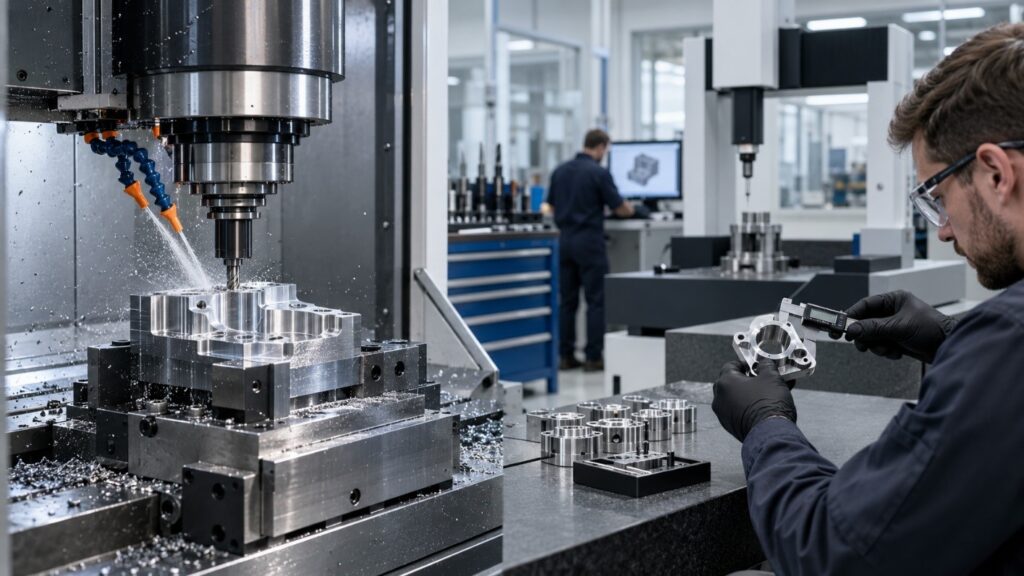
Accurate machining depends on the complete manufacturing process rather than the CNC machine alone.
Tool selection, tool condition and cutting strategy can all affect the finished component. Workholding is equally important because the part needs to remain stable and correctly located throughout machining.
Material behaviour also matters. Different metals and engineering materials respond differently to cutting forces and heat, so the machining approach needs to reflect the material as well as the drawing.
Programming, component geometry and the number of setups can introduce further considerations. Where several machining operations are required, careful process planning helps maintain the required relationship between critical features throughout manufacture.
This is why engineering judgement matters alongside machine capability in quality CNC machining.
Why Is Quality Control Crucial in CNC Milling Services?
Quality control provides a structured way to confirm that the machining process is producing the required result.
Where appropriate, dimensions can be checked during manufacture rather than waiting until every machining operation has been completed. These checks provide evidence that specified features remain within requirements and help the engineering team understand whether the process is continuing as intended.
Final inspection then provides another opportunity to verify the relevant dimensions and features before the component progresses to assembly, further processing or delivery.
Quality control is therefore not separate from precision machining. It is the process used to confirm that the required level of accuracy has actually been achieved.
What Does CNC Milling Inspection Involve?
CNC milling inspection involves comparing specified component features and dimensions with the requirements shown on the engineering drawing or agreed specification.
The most suitable inspection method depends on the geometry of the part, its tolerance requirements and the features that need to be measured. Equipment may include precision measuring instruments, gauges and coordinate measuring machines.
A CMM can be particularly valuable where complex geometries or positional relationships between features need to be checked accurately.
At GWH, we have an in-house inspection team using a large CMM for tight-tolerance work. Quality procedures are followed during and after manufacture, with quality data records retained to support traceability.
Learn more about GWH’s CMM inspection capability.
How Can Quality Control Reduce Manufacturing Risk?
Identifying a problem earlier in the manufacturing process can reduce its impact.
On a complex or heavily machined component, considerable time and material may be invested across several operations. If a dimensional issue is discovered only after those operations have been completed, the result may be additional machining, rework or disruption to the wider production schedule.
In-process inspection allows the engineering team to identify variation before unnecessary work continues. Where several components are being produced, it can also help prevent the same issue from progressing through a larger batch.
For buyers assessing precision manufacturing services, the ability to inspect, record and respond to manufacturing results can therefore be just as important as the machining equipment itself.
What Should You Look for in a CNC Milling Supplier?
A capable CNC milling supplier should offer more than suitable machinery. The wider manufacturing and quality process needs to match the requirements of the component.
When comparing suppliers, consider:
- CNC milling capability appropriate to the component size and complexity
- Experience machining the required material
- Effective workholding and process planning
- Suitable inspection and measurement equipment
- Established quality management procedures
- Traceability where the project requires it
- Clear technical communication before machining begins
The supplier should also understand which dimensions and relationships are critical to the component’s function, rather than viewing the drawing simply as a set of features to machine.
GWH operates seven CNC millers, including 4-axis machines, supported by ISO 9001 certification and in-house inspection capability for substantial, complex and technically demanding components.
Why Precision and Quality Control Need to Work Together
Precision is achieved through a controlled machining process, while quality control provides the evidence needed to verify the result.
Bringing machining, inspection and process planning together helps manufacturers maintain consistency and identify potential issues at the most suitable stage of production.
For engineering and procurement teams, this helps reduce the risk of dimensional or inspection issues being discovered later in the manufacturing process.
Discuss Your CNC Milling Requirements
If your project involves tight tolerances, complex features or specific inspection requirements, send us your engineering drawing for review.
Include details of the material, quantity and any relevant inspection requirements so the team can understand the component and determine how best to manufacture and inspect it.
Request a CNC machining quote.
Frequently Asked Questions
What affects CNC milling accuracy?
CNC milling accuracy can be influenced by machine capability, tooling, workholding, programming, machining strategy, material behaviour and tool condition. Each factor needs to be considered as part of the overall manufacturing process.
What is CNC milling inspection?
CNC milling inspection involves measuring specified dimensions and features on a machined component and comparing them with the requirements shown on the engineering drawing or agreed specification.
What is a CMM used for in CNC machining?
A coordinate measuring machine, or CMM, is used to measure component geometry and positional relationships between features. It can be particularly useful where complex shapes or high-accuracy dimensions need to be verified.
When should CNC components be inspected?
Inspection can take place during manufacture as well as after machining is complete. The inspection stages depend on the component, its critical features and the requirements of the project.
When is CMM inspection useful for a machined component?
CMM inspection can be useful where a component contains complex geometries, closely related features or dimensions that require accurate positional measurement. The most suitable inspection method depends on the drawing and specified requirements.
What information should I provide when requesting a CNC milling quote?
Providing an engineering drawing, material specification, required quantity and any relevant inspection requirements helps the machining team understand the component and decide how best to manufacture and inspect it.